TRANSMISSION CONTEST
| The transmission contest was the first of two group projects for Design and Fabrication (ME14). The ultimate goal of the contest was to design and manufacture a gearbox to mate a motor to a free-spinning bicycle wheel. Gearboxes were scored based on how quickly they accelerated the wheel and the wheel's final RPM. To that end, we built a planetary gearbox, both because a planetary gear arrangement is generally more efficient than a two-stage spur gear arrangement, and because the design would be an interesting challenge. There were plenty of examples of other gearbox types from previous competitions; none were planetary gearboxes. One early challenge we encountered was the ring gear limiting both our choices of gearbox ratio and our budget. We were forced to select a less-than-optimal 6.5:1 ratio, and drop the number of planet gears from 3 to 2. The best solution to this (waterjet our own gears) wasn't allowed under competition rules. The major issue we encountered during testing was a misalignment between the ring gear and the planetary gears, probably due to errors during machining. The gearbox ran best when the ring gear was allowed to wobble slightly; if it was fully constrained, the gears started to wear against each other, to the point that aluminum dust was visible beneath the gears after only a short amount of run time. While the end product wasn't perfect, this project left me with a newfound appreciation for planetary gearbox design, valuable machining experience, and a reminder to account for manufacturing error during the design process. Here's a link to the github repo containing our CAD files. | 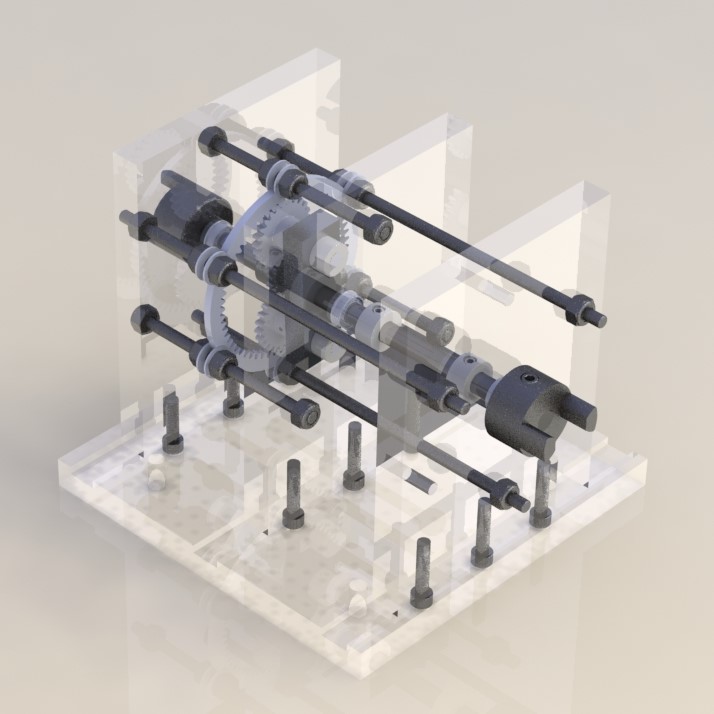 A render of the finished transmission |
The planetary gears in motion |